 |
Descartes,
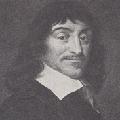
Rene French philosopher Born: La Haye, Tours, France, March 11, 1596 Died: Stockholm, Sweden, February 11, 1650 | |||||||||
| "I think, therefore I am" - Rene Descartes Aristotle Democritus Descartes Plato Pythagoras Socrates |
Descartes was a sickly child, inheriting his health problems from his mother, who died when he was one year old. He studied under the Jesuits and after some years in an administrative position in the French army, he settled in Protestant Holland.
Descartes was a mechanist in his approach to philosophy, and he began by doubting everything. The presence of doubt implied the existence of something, hence providing proof of his own existence. He expressed this in the Latin phrase "Cogito, ergo sum", I think, therefore I am. The system he developed from this approach was sufficiently impressive to earn him the title: Father of Modern Philosophy. Descartes applied his mechanistic views to anatomy, and military science, but his most important contribution to science came in the form of geometry and mathematics.One day while observing a hovering fly, it occurred to him that the flys position could be described by locating the three mutually perpendicular planes that intersected at the position of the fly. He saw that by using a reference point, three sets of two points could pinpoint an object in three-dimensional space. These points became known as Cartesian points, because the latin name Descartes used as a scholar was Renatus Cartesius. The Cartesian points could also be used in algebra to create curves of movement, usually parabolic in nature. This application of algebra to geometry by Descartes went on to pave the way for the development of calculus by Newton. As one of the names for algebra at that time was "analysis", this system which fused two branches of mathematics became known as analytic geometry. Descartes was invited to the Swedish court in September 1649, where he was asked to instruct the queen, Christina, in philosophy. The strain was too much for his delicate health, and he died of pneumonia. His body was returned to France for burial, except for his head, which, in 1809, came into the posession of Berzelius. | |||||||||
| ||||||||||
vb-tech.co.za